



Right now, it feels like every company is diving headfirst into generative AI. Teams are leveraging tools, departments are rolling out pilots, and leaders are pouring resources into AI initiatives. It's awesome. But despite all this energy, most organizations are still struggling to achieve true transformation, where AI isn’t just a shiny experiment that delivers marginal productivity gains, but a core part of how you operate, innovate, and even think — and this is harder than you (read: your board) may have initially thought.
Each stage of the AI maturity journey brings new technical, operational, and cultural challenges. Regulated industries like healthcare, finance, and the public sector face additional challenges that make it harder to spin up AI projects quickly. If you’re a nimble startup you can move fast. But for highly regulated industries? You can’t just “move fast and break things” when those “things” are people's bank accounts or medical records.
To move from a pilot to an AI powerhouse, you have to understand where you are in your AI maturity journey. In this post, we’ll focus on the most critical jump: moving from pilot to production.
The enterprise AI maturity model
Enterprise AI adoption typically follows a predictable, five-phase progression.
- Experimentation: Individuals and teams are exploring AI tools in silos. Some teams may be running isolated pilots and proof-of-concept projects
- Tool adoption: Momentum has begun and teams are adopting specific AI workflows with increasing confidence
- Internal platforms: The organization takes AI to the production level, building a centralized AI infrastructure that allows them to govern and scale
- Strategic integrations: AI is being integrated into core products and operations and is becoming an integral part of mission-critical systems
- AI-native transformation: The entire company has redesigned itself around AI capabilities, transforming its workforce and culture
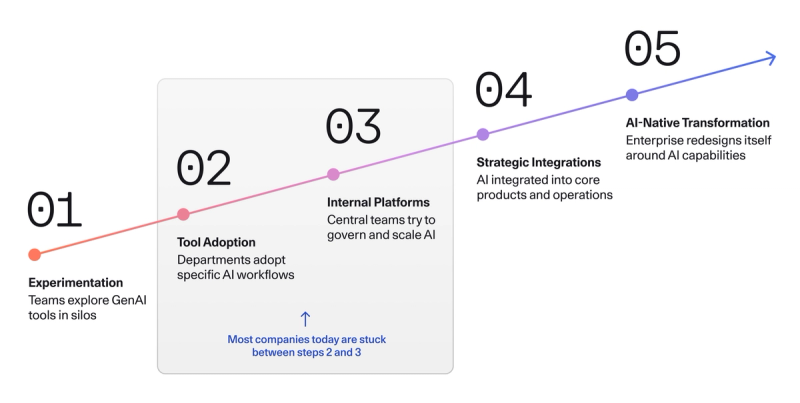
Most companies today become stuck between Phase 2 (Tool Adoption) and Phase 3 (Internal Platforms), failing to truly integrate AI into their core tech stack. Let’s take a closer look at the early stages of the journey and the challenges of moving from Phase 2 to Phase 3.
From ad-hoc experiments to tool adoption
In the beginning, AI adoption looks less like a strategy and more like a grassroots movement. Teams start exploring generative AI tools on their own, often grabbing whatever consumer-grade solutions are within reach to make their Mondays a little easier. You’ll see isolated pilots popping up in random corners of the org and small proof-of-concept projects emerging from the most tech-forward departments. Phase 1 is effectively universal; at this point, if your employees aren't experimenting with AI, they’re likely just not telling you about it.
The growing pains of "shadow AI"
The core challenge here is that while the energy is great, the oversight is nonexistent. When employees use AI tools in a vacuum, they inadvertently introduce a host of "unforced errors," from shadow AI usage and data exposure risks to a complete lack of alignment with actual enterprise priorities.
Most companies naturally transition out of Phase 1 to Phase 2, usually triggered by a mix of leadership intervention and a sudden, urgent need for centralized guardrails. The shift to Phase 2 happens when the organization stops just watching from the sidelines and starts providing official access to vetted AI tooling and structured education.
From tool adoption to internal platforms
By the time an organization hits Phase 2, the "Wild West" has been tamed. Teams are comfortable, departments are deploying tools for specific workflows, such as internal copilots, AI-assisted customer support, automated document analysis and knowledge retrieval, and there’s a general sense of momentum.
Most organizations are currently parked right here. They’re scaling, but the efforts are fragmented. They’ve got a dozen "success stories" that don't actually talk to each other, lacking the centralized infrastructure, consistent AI governance, and strategic alignment needed to move the needle at the enterprise level.
The production wall
The transition from a polished proof-of-concept (Phase 2) to a production-ready system (Phase 3) is where many initiatives go to die. As an organization tries to scale, three specific barriers tend to show up uninvited:
- Data access: Live data remains siloed behind IT gates, forcing teams to rely on static files that hinder automation. Without a unified data fabric, AI integration becomes impossible.
- Trust gaps in LLMs: LLMs can be black boxes. That opacity fuels legitimate fears around data leakage and compliance, often stalling adoption even after the technical hurdles are cleared.
- A new kind of FOMO: Instead of the fear of missing out, teams are paralyzed by the fear of model obsolescence. The sheer pace of new model releases creates a paralyzing uncertainty. Leaders worry that a decision made today will be obsolete in six months, leading to a "wait and see" approach that effectively kills momentum.
To graduate to Phase 3, you have to stop thinking about AI as "tools" and start thinking about Internal Platforms. This requires building a unified data fabric, a system that ensures secure data flows across the entire enterprise. Crucially, IT teams need to have complete confidence in connecting enterprise data to AI models. For highly regulated industries, this means bringing these models to their data, and not the other way around.
You also need observability frameworks, model explainability, and rigorous audit trails that pull back the curtain on the "black box." AI governance here must be purposeful and clear enough to mitigate risk, but flexible enough that it doesn't become a bottleneck for innovation.
Finally, you might want to consider an architecture that allows for model optionality. In a world where the "best" LLM changes and can be different based on an individual use case, your platform needs to be the constant, not the variable.
Final thoughts
The "Production Wall" between Phase 2 and 3 is the most critical hurdle you will face. Nailing the basics of Phase 3 - governance, observability, and optionality - is what earns you the ability to innovate at scale.
In Part 2 of our series, we’ll explore what happens once that foundation is set: moving from Internal Platforms to Strategic Integrations, including the barriers you need to overcome to allow you to stop "using" AI and start embedding it into the mission-critical systems that drive competitive differentiation. And finally, we'll take a look at the holy grail of the AI-Native Enterprise.
Get started on your AI maturity journey
Ready to bridge the gap between pilot and production? From foundational models to enterprise-grade platforms, Cohere has built the entire AI vertical stack to help organizations turn GenAI into a non-generic source of competitive differentiation. Request a demo and see how Cohere can help you unlock AI’s potential at your organization.