


In our previous post, we explored the "production wall" in an organization’s AI adoption journey, the difficult jump from experimental AI tools to a centralized internal platform. But building the platform is only half the battle. The real question for leadership isn't just "How much operational expense is AI saving?" but also "Is AI accelerating top-line revenue and operating momentum?"
To answer that, we need to look at the final, most ambitious phases of the AI Maturity Model: Strategic Integrations and AI Native Transformation.
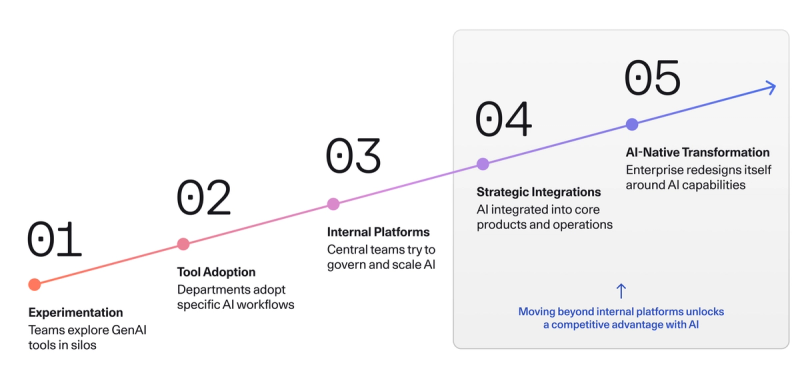
Most companies scale their tech, but fail to scale their vision. They use AI to do the same things slightly faster, missing the "double dividend" of simultaneously elevating the daily lives of employees while accelerating top-line revenue. Before we dive into how to move into Phases 4 and 5, let’s first address how we assess whether or not we’re actually getting there.
How companies measure AI success
When evaluating AI initiatives, most organizations tend to focus on two familiar metrics: ROI and engagement.
With ROI, executives understandably want to see measurable business value. They look at how AI is helping them increase efficiency, improve quality, drive financial growth, or reduce risk. But AI systems only create value if people actually use them. So, organizations also track engagement metrics, such as usage frequency, feature adoption, and workflows impacted, to understand whether or not AI is becoming part of everyday work.
It all makes sense, but ROI and engagement only tell part of the story.
Workforce transformation: A strategic imperative
The real reason that companies invest in AI is not to simply optimize existing processes, but to take advantage of its ability to actually reimagine how work gets done. This requires measuring a third, often overlooked pillar: workforce transformation.
Key indicators of workforce transformation include:
- Skill uplift: The percentage of workforce trained or certified at different AI proficiency levels
- Throughput: Measuring if AI-accelerated workflows are resulting in more work actually landing, moving from "hours saved" to "increased organizational velocity"
- AI maturity: Organizational progress from experimentation to scaled, AI-driven innovation
- Culture and trust: Employee survey results on confidence, trust, and willingness to partner with AI
Organizations that track these indicators can then begin to explore a deeper question: “Is AI transforming how our company operates?” Answering that question requires understanding how we move from Phase 3 to Phase 4, and ultimately, to Phase 5.
From internal platforms to strategic integrations
In Phase 3, your central teams have built the "scaffolding": the governance, data pipelines, and evaluation systems that act as the connective tissue for the organization. While many aim for this robust, production-ready environment, only a handful have achieved it.
The leap into mission-critical AI
Once you have the platform, the goal is to stop "using" AI and start embedding it into the systems that actually run your business (Phase 4). This is the shift from generic utility to competitive differentiation, and it presents three interconnected hurdles:
- Cost complexity: Welcome to the world of "unknown unknowns." Between infrastructure, inference, and the sheer engineering muscle required, predicting your Total Cost of Ownership (TCO) becomes a bit of a dark art. Multi-use case deployments don't just add up; they compound as your use cases increase in complexity.
- Sovereignty risks: You need scale and performance, but you can’t afford to compromise data integrity or become entirely beholden to a third party’s roadmap. Relying entirely on a third-party provider for the "brains" of your operations creates a massive strategic dependence that most critical industries aren’t comfortable with. It’s about balancing "fast innovation" with "long-term control."
- Talent chasm: There is a chronic shortage of people who actually know how to build, test, and most importantly, rigorously evaluate these systems to embed into enterprise.
To clear these hurdles and move from "using AI" to owning a truly proprietary asset, it’s about playing the long game with a bit of strategic foresight.
- Prioritize sovereign ownership: Don’t just rent your future. Owning your AI stack is about both security and a valuation play. It ensures that you aren’t creating a strategic dependency that could be priced out or pivoted away by a vendor later.
- Partner with precision: Independence doesn’t have to mean going it alone. The goal is to find strategic partners, whether they are consultants or platform specialists, who act as an extension of your team. Look for those who bring the specific technical depth you need while staying completely aligned with your vision.
- Invest in re-skilling: AI transformation is as much about your team as it is about the tech. While external help is great for getting started, you’ll find the most success by reskilling your existing teams. It’s the best way to bridge the AI-engineering gap and build a culture of self-reliance that keeps you moving long after the first implementation is done.
From strategic integration to the AI-native enterprise
By Phase 4, AI is a standard feature. You’ve got AI-native products, real-time decision systems, and automated workflows that have largely replaced manual oversight. Achieving this is a massive feat. You’ve spent Phases 1 through 4 building the groundwork and chasing efficiency gains, but haven't yet pulled the trigger on AI’s true potential: acting as a catalyst for entirely new business models.
Many organizations stop at augmentation and automation. They use AI to do the same things, just faster or cheaper. They’ve optimized the past rather than invent the future.
The reimagination of work
The sticking point is that many organizations stop at augmentation and automation. They use AI to do the same things, just faster or cheaper. They’ve optimized the past rather than invent the future. To make the leap to Phase 5 (which is truly aspirational), you have to move beyond "doing work better" to reimagining the work itself. This requires a fundamental rethink of workflows, roles, and most importantly, expected outcomes.
Enterprises miss the growth opportunity that Phase 5 offers due to two specific traps:
- It’s easy to conflate tactical automation (doing things faster) with strategic innovation (doing things differently). This is a massive cognitive leap. Reimagining entire industries, organizations, and job roles is objectively hard work. There is no historical playbook for this, and no one has "done it before" in this specific way. It’s much more comfortable to automate a spreadsheet than it is to rethink why that spreadsheet exists in the first place.
- This isn't just a digital transformation, it’s a massive change-management lift. You aren't just swapping out software, you’re rethinking KPIs, incentives, and the very structure of the organization.
The AI-native enterprise
In Phase 5, the enterprise doesn't just use AI, it redesigns itself around it. Instead of layering technology onto legacy processes, the organization reimagines how value is created from the ground up.
These AI-native pioneers are characterized by autonomous decision systems, fundamentally restructured professional roles, and high levels of AI fluency across the board. They are unlocking business models that were technically impossible five years ago. While only a select group of leaders have reached this level, the competitive advantage they are building is becoming a chasm that traditional firms will find hard to bridge.
Start Phase 5 on Day 1
Don’t wait until Phase 5 to begin thinking like an AI-native company; start at the beginning:
- Educate for transformation: Your Chief Human Resources Officer shouldn’t be on the sidelines, they need a seat at the AI table. It's important to invest early in AI literacy programs that encourage creative, forward-thinking, reimagined workflows from Day 1.
- Don’t let consumer chatbots set your expectations: It’s easy to get distracted by "micro-innovation" — the neat little tricks making current workflows quicker. But for the enterprise, the real gold is in macro-innovation: large-scale, mission-critical use cases that actually move the needle on how you serve your customers.
- Executive storytelling: If your North Star is only cost-cutting, you’ll never see the new revenue streams. Frame your early wins as more than just savings, use them to tell a story of growth.
Final thoughts
The reality is that no organization moves through this as a perfectly unified front. You likely have one department sprinting toward Phase 5 while another is still tentatively Googling, "What is an LLM?" You might even have a rogue team that tried to go straight to Phase 4 and is now dealing with its ramifications. It’s a messy, inconsistent blend, but the goal is to look at the organization as a whole, identify where you've skipped the load-bearing steps, and figure out how to pull the laggards forward without letting the sprinters run off a cliff.
And let’s be real: being at "Phase 5" is a moving target. What looked like peak maturity two years ago is now just the cost of entry to stay in the game. This scale is constantly evolving, and even the best of us are still figuring out the parts that don't quite fit yet. But through all the noise of cost-cutting and efficiency, don't lose sight of the ultimate goal (read: demands of boards and investors) of AI-driven reacceleration of your top-line revenue and operating momentum.
Get started on your AI maturity journey
Looking for a technology partner to take your organization from Phase 1 to Phase 5? From foundational models to enterprise-grade platforms, Cohere has built the entire AI vertical stack to help organizations turn GenAI into a non-generic source of competitive differentiation. Request a demo and see how Cohere can help you unlock AI’s potential at your organization.