





Over the past year, enterprises and governments have confronted a hard truth: AI systems that rely on external infrastructure can be disrupted without warning by decisions and actions outside their control. Recent model access restrictions and several high-profile cybersecurity incidents have become a global wake-up call, exposing how fragile technological dependencies can be.
These events highlight a broader structural challenge. When AI is delivered exclusively through centralized big tech platforms, organizations inherit external dependencies that introduce operational, regulatory, and geopolitical risk. As a result, enterprises and public institutions are reassessing their AI strategies to avoid single points of failure, reduce vendor lock-in, and ensure mission‑critical workflows remain available, secure, and resilient. Increasingly, critical industries operating with sensitive data in high-risk environments — from healthcare and financial services to energy, telecommunications, manufacturing, and more — are seeking to control, not rent, their AI.
Against this backdrop, Cohere commissioned analyst firm IDC to conduct a study focused specifically on sovereign AI adoption among senior enterprise decision-makers in highly regulated industries. The findings reveal a disconnect: “while more than half of executive leaders believe sovereign AI is a priority, there is little agreement on the definition, and many cannot define it.” This understanding of requirements and readiness lags in many organizations.
What we set out to learn
When we began our research in early 2026, we noticed a gap in existing commercial AI studies. Most focused either on general public sentiment or narrow consumer app usage trends. Few examined how enterprise AI buyers and influencers — such as directors, VPs, CIOs, CTOs, CISOs — think about issues like data ownership, governance, security, and operational control.
We wanted to better understand:
- How do leaders define sovereign AI?
- Where are the gaps in awareness and strategy?
- What are the blockers to successful implementation?
- How do priorities differ across industries and geographies?
The results identified a clear need for shared definitions, training, and actionable strategies for C-suite leaders.
How leaders define sovereign AI
One of the most striking findings: one in three leaders had difficulty describing sovereign AI in their own words. The IDC InfoBrief defines sovereign AI as “the ability for an organization to have free choice and control over the design, development, deployment, accessibility, operation, maintenance, and governance of its AI systems and applications, as well as the underlying technology foundations they depend on.”
Among those who could define sovereign AI themselves, 52% of leaders explicitly describe it in terms of local or national control and 35% invoke digital independence.
Interpretations also diverged by role. Line-of-business (LOB) leaders primarily view sovereign AI as a means for managing business risk, including data security, privacy, and cost controls. IT leaders, by contrast, view sovereign AI through the lens of regulatory compliance, ensuring that systems meet national and regional requirements. Notably, IT professionals show two times higher awareness than LOB leaders.
Cohere’s view
At Cohere, we share this perspective. Our unique private deployment architecture gives organizations full control over their AI systems, ensuring local data control, regulatory compliance, and true digital sovereignty.
Cohere’s models and agentic AI platform North run entirely within a customer’s chosen infrastructure and jurisdiction, with no risk of external shutdown or remote override. North provides hardened security, strict privacy controls, and flexible deployment options across private on-premises environments and fully air-gapped settings.
This matters in practice. Healthcare organizations, for example, often require dedicated infrastructure to protect sensitive patient information, support secure clinical workflows, and integrate with existing hospital systems. But this is only one part of a broader shift: as AI becomes the control layer for critical infrastructure, from financial systems and energy grids to telecom networks and manufacturing supply chains, sovereign AI is an operational necessity.
IDC predicts that “By 2028, CIOs at multinational organizations will boost investments in modular, sovereign-ready cloud and data localization environments by 65% to future-proof operations against rising sovereignty demands.” Source: IDC FutureScape: Worldwide CIO Agenda 2026 Predictions.
Three blockers slowing sovereign AI adoption
The IDC InfoBrief is divided into three parts that we believe explain why adoption remains uneven:
- “Defining the need for AI autonomy”: Enterprises recognize the risks of vendor lock‑in and portability gaps, but lack a clear blueprint for operationalizing sovereignty. They must also defend against growing cyber and geopolitical risks, as well as meet data residency requirements (GDPR, EU AI Act, and others).
- “Understanding gaps and awareness”: Only 13% of leaders are “very widely” aware, revealing a fragmented and inconsistent grasp of the concept across global organizations. This means buyers or influencers may be making AI investment decisions without sufficient context.
- “Building a holistic strategy”: Organizations must bridge the awareness-to-action gap by creating a strategic vision and plan to achieve ownership over their AI systems, with measurable goals, clear responsibilities, and leadership alignment. The full study outlines which responsibilities are critical to success and which C-suite roles should own the strategy. Hint: it depends on the country.
Key findings from the IDC InfoBrief
The research uncovered common concerns and drivers of sovereign AI adoption across industries and geographies. Two are of particular interest.
Data leakage and compliance are top concerns
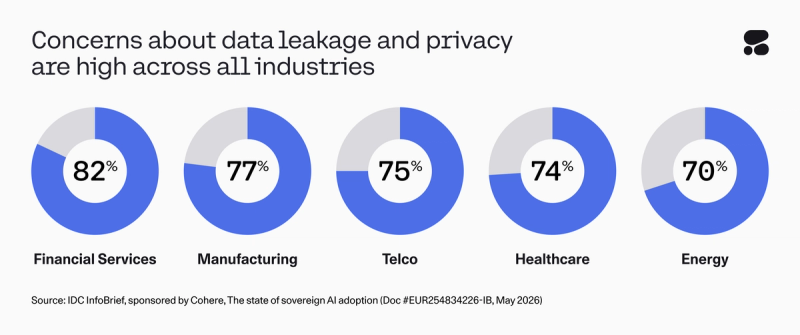
Across every industry surveyed, enterprise leaders identified data leakage, privacy, compliance, and regulatory risk as the top concerns that sovereign AI initiatives can address. Furthermore, the largest enterprises with $20B USD in revenue are much more risk-aware than small firms. What is interesting, is how even without an agreed-upon definition, the consensus on the importance of privacy and security is clear.
- Financial Services 82%
- Manufacturing 77%
- Telco 75%
- Healthcare 74%
- Energy 70%
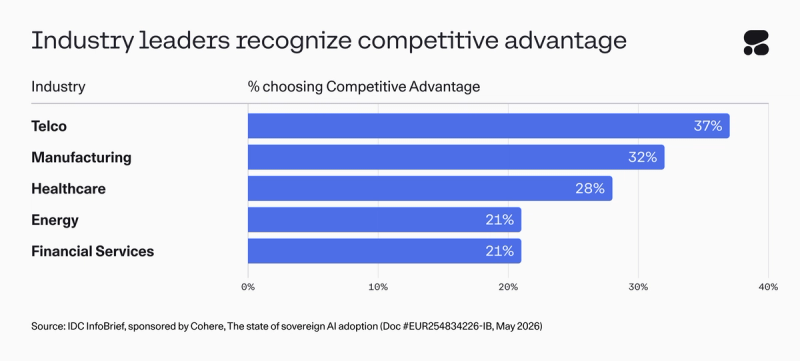
Competitive advantage is also an emerging trend
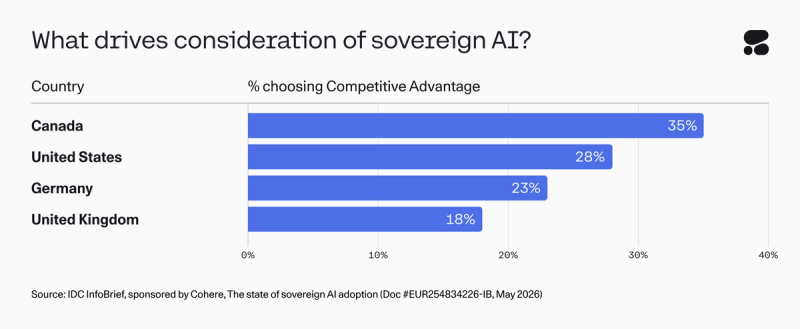
As enterprises move beyond experimentation, many see sovereignty as a path to stronger security, reduced dependence on external providers, and market differentiation. Competitive advantage is not yet a top concern — but momentum is building.
Across geographies:
- 35% in Canada and 28% in the United States
- 23% in Germany and 18% in the United Kingdom (reflecting the higher focus on regulatory frameworks)
And industries:
- Telco 37%
- Manufacturing 32%
- Healthcare 28%
- Financial Services 21%
- Energy 21%
Conclusion: Sovereign AI is now a strategic imperative
The IDC InfoBrief findings are clear: “Across regulated industries and geopolitically sensitive markets, enterprises are re-architecting their digital operating models — shifting from a global-by-default posture to a deliberately sovereign-by-design approach.”
We believe the study is a call to action for enterprises and governments to:
- Define sovereign AI in operational terms
- Quantify its business value
- Establish ownership across leadership teams
- Build systems that remain available and secure regardless of external events
To explore the full findings, fill out the form below to download the complete IDC InfoBrief.
Download the InfoBrief now
About the state of sovereign AI adoption InfoBrief
“The state of sovereign AI adoption” InfoBrief was commissioned by Cohere and conducted by IDC to explore how organizations are approaching sovereign AI adoption. To better understand awareness, barriers, and investment, we surveyed over 500 senior decision-makers and influencers responsible for AI purchasing within their organizations.
Respondents represented large enterprises with over $1 billion USD in annual revenue across Canada, the United States, the United Kingdom, and Germany. The study was fielded from April to May 2026.
The sample spanned the regulated industry segments most affected by sovereign AI considerations, including healthcare and life sciences, financial services, public sector, energy, manufacturing, and telecommunications.
Unless otherwise noted, all data points are attributed to IDC InfoBrief, sponsored by Cohere, The state of sovereign AI adoption (Doc #EUR254834226-IB, May 2026).