














Why is owning your AI important?
AI systems that power many regulated organizations rely on external infrastructure.
Infrastructure that can be disrupted without warning.
Infrastructure subject to decisions and actions outside of a company’s immediate control.
We’ve already seen it play out. Recent model access restrictions and high-profile cybersecurity incidents expose how fragile those dependencies can be.
That made us wonder…
- How do leaders define AI ownership?
- Where are the gaps in awareness and strategy?
- What are the blockers to successful implementation?
- How do priorities differ across industries and geographies?
To find the answers, we commissioned analyst firm, IDC, to research the state of sovereign AI adoption and find out how to empower enterprises to own their data. Scroll on to see a brief preview of the IDC InfoBrief.
Key findings from the InfoBrief
A few surprising data points illustrate the state of sovereign AI.
1. How do leaders define AI ownership?
Just over half of respondents describe sovereign AI in terms of local/national control. However, the lack of a clear, industry-wide definition means there are a half-dozen other categories in which sovereign AI can be described.
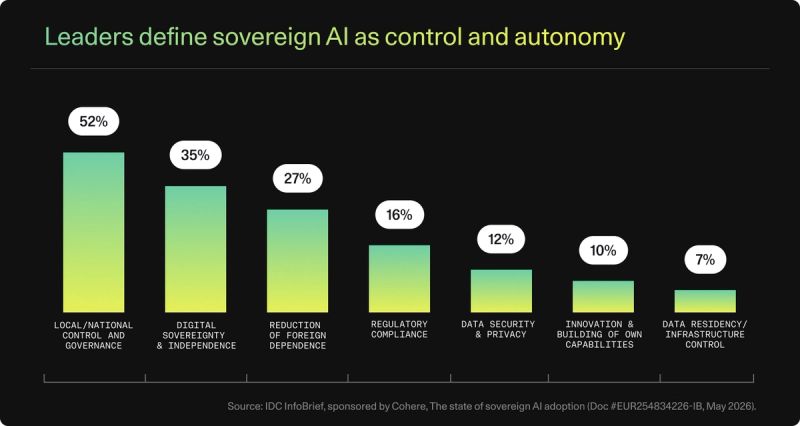
That’s not all. One in three had difficulty describing it in their own words. In the full InfoBrief, see how this awareness gap translates across organizations in Canada, Germany, the UK, and the US.
2. Where are the gaps in awareness and strategy?
A strong leader—and champion of sovereign AI—is needed. Without an established industry standard for how sovereign AI initiatives are managed, no one is completely certain.
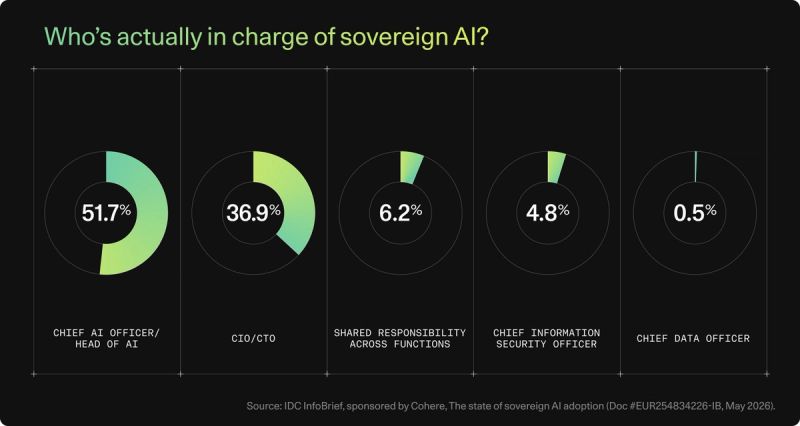
The data above is an aggregate of all geographies, but the answers varied significantly by country. The InfoBrief depicts which roles are most favored in each country.
3. What are the blockers to successful implementation?
There is little consensus among the barriers, which demonstrates how fragmented the concept is. That said, infrastructure and cost were the biggest concerns.
Here’s what we heard from one leader:
“We need stronger infrastructure before handling sovereign AI confidently internally.”
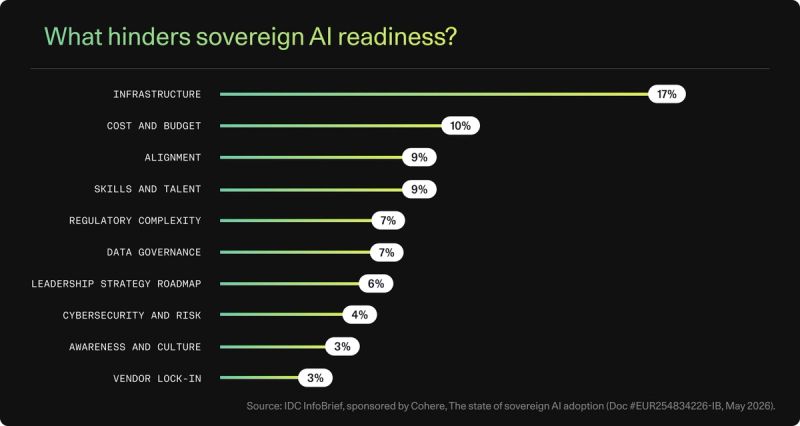
Read what other leaders identify as blockers in the full InfoBrief.
4. How do priorities differ across industries and geographies?
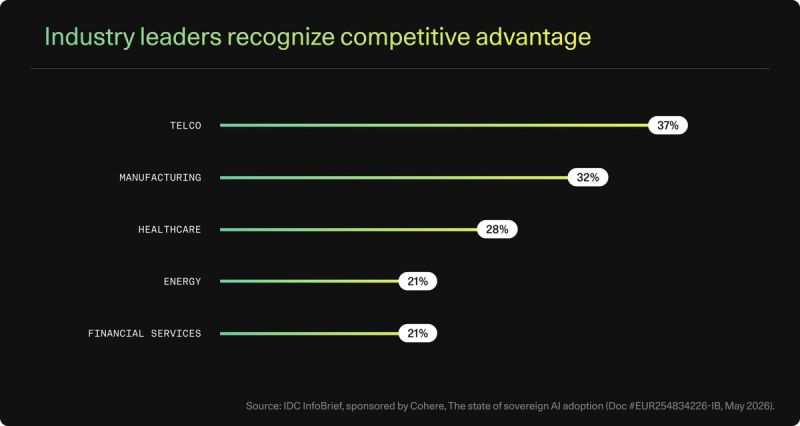
Across every industry surveyed, enterprise leaders identified data leakage and compliance as the top concerns that sovereign AI initiatives can address. What is interesting, is how even without an agreed-upon definition, the consensus on the importance of privacy and security is clear.
Cohere’s perspective on sovereign AI
At Cohere, our private deployment architecture gives organizations full control over their AI systems, ensuring local data control, better regulatory compliance, and true digital sovereignty.
Cohere’s models and agentic AI platform North run entirely within a customer’s chosen infrastructure and jurisdiction, with no risk of external shutdown or remote override. North provides hardened security, strict privacy controls, and flexible deployment options across private on-premises environments and fully air-gapped settings.
Who we surveyed
A full methodology is available in the InfoBrief, but many of the leaders surveyed are likely your peers. The study was conducted from April-May 2026.
500+ leaders
*Director and higher, responsible for AI purchasing in their organizations
Business roles
Technical roles
Four countries
in Canada 🇨🇦
in the United States 🇺🇸
in the United Kingdom 🇬🇧
in Germany 🇩🇪
Six industries
- Financial services
- Healthcare
- Telecommunications
- Energy
- Manufacturing
- Public sector
Functional areas
- Finance
- Human Resources
- Procurement
- Operations
- Marketing
- IT