





Today, we're releasing Embed 5, a new family of embeddings models at the frontier of high-quality enterprise retrieval.
Embed 5 delivers stronger retrieval across complex enterprise data while giving teams more control over latency, cost, and deployment. Embed 5 Pro is optimized for maximum quality across multimodal, multilingual, financial, code, and parsed-document retrieval. Embed 5 Fast brings highly competitive performance to latency- and cost-sensitive workloads. Both tiers share a single embedding space, so teams can index with Pro and query with either model without rebuilding the index.
Embed 5 establishes the retrieval foundation for search, RAG, and agentic workflows, surfacing more relevant context while filtering out noise before it reaches expensive generative models. Use Embed to improve answer quality and user experience while helping keep downstream inference costs under control.
Embed 5 is generally available today on the Cohere API and Model Vault, Microsoft Foundry, and Amazon SageMaker. Pricing is $0.12 per million tokens for Pro and $0.08 per million tokens for Fast.
Snapshot
| Capability | Embed 5 Pro | Embed 5 Fast |
|---|---|---|
| Best for | Maximum retrieval quality; offline indexing; complex enterprise corpora | Interactive search; high-volume RAG; agentic retrieval |
| Context length | 128K tokens | 128K tokens |
| Inputs | Text, images, fused text + image | Text, images, fused text + image |
| Languages | 100+ | 100+ |
| Output dimensions | 2048, 1536, 1024, 768, 512, 256 | 2048, 1536, 1024, 768, 512, 256 |
| Embedding formats | float, int8, binary | float, int8, binary |
| Matryoshka embeddings | Yes | Yes |
| Shared embedding space | Yes | Yes |
| Supports self-hosting | Yes | Yes |
| Pricing | $0.12 / 1M tokens (text) $0.40 / 1M tokens (image) |
$0.08 / 1M tokens (text) $0.40 / 1M tokens (image) |
Performance
Embed 5 Pro delivers our strongest retrieval performance to date. It achieves the highest average score of any model we tested across ViDoRe V3, financial documents, parsed PDFs, image retrieval, and across key business languages.
Embed 5 is also the first model family evaluated with RCP-nDCG@10, our latest retrieval methodology. Instead of scoring only against a limited set of fixed labels, it evaluates retrieved documents against query-specific relevance criteria, capturing relevant results and giving a fuller view of performance on your own corpus.1 Read more about RCP-nDCG@10.
Enterprise documents
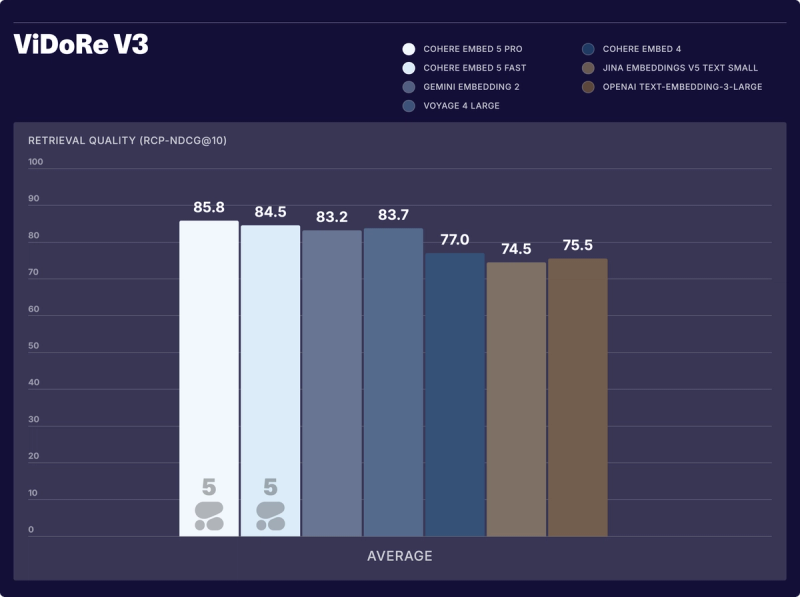
Embed 5 excels with visually rich documents where meaning lives in tables, charts, diagrams, and layout — not just text. On ViDoRe V3, which features documents sampled across key enterprise domains, including financial filings, technical manuals, regulatory material, government reports, textbooks, and lectures, Embed 5 Pro averages 85.8 — an impressive 8.8 gain from Embed 4.2
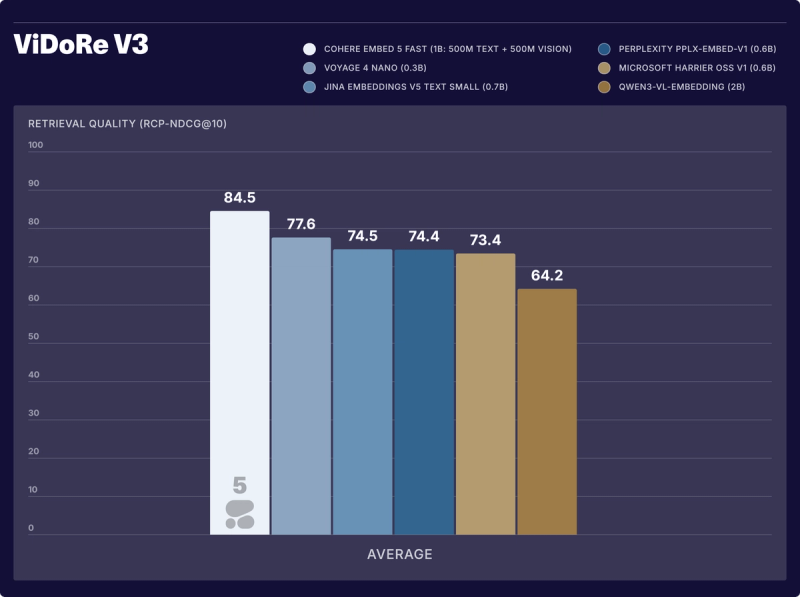
That puts it ahead of Voyage 4 Large (83.7), Gemini Embedding 2 (83.2), and OpenAI text-embedding-3-large (75.5). Pro leads five of the eight domains outright and ties Voyage 4 Large on energy, with its largest gains over Embed 4 on HR (+11.4) and industrial (+10.3). Embed 5 Fast averages 84.5, ahead of both Gemini Embedding 2 and Voyage 4 Large. See the full results here.
Finance
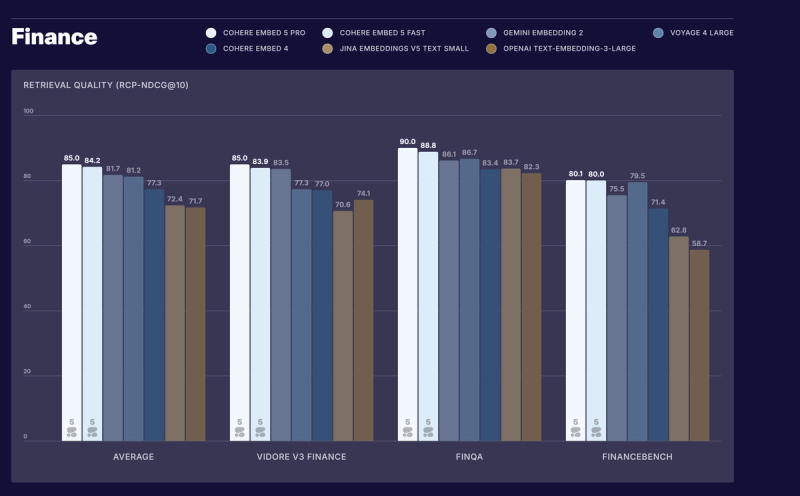
Embed 5 Pro establishes itself as the leading embeddings model for financial document retrieval.
Pro ranks first on three leading public financial benchmarks, with Fast second on each despite being considerably smaller than its peers: FinanceBench (80.1 Pro, 80.0 Fast), FinQA (90.0, 88.8), and ViDoRe V3 Finance (85.0, 83.9).
Across these, Pro averages 3.3 points higher than the next non-Cohere competitor, Gemini Embedding 2. Compared with OpenAI text-embedding-3-large, the lead grows to 21.4 points on FinanceBench.
Multimodal
Parsed PDFs
Most enterprise search pipelines still convert PDFs to text before embedding them, but that process can strip away structure. Tables lose row and column relationships, multi-column layouts can scramble reading order, repeated headers add noise, and charts often disappear entirely. That makes parsed-document retrieval a harder test than clean-text benchmarks suggest.
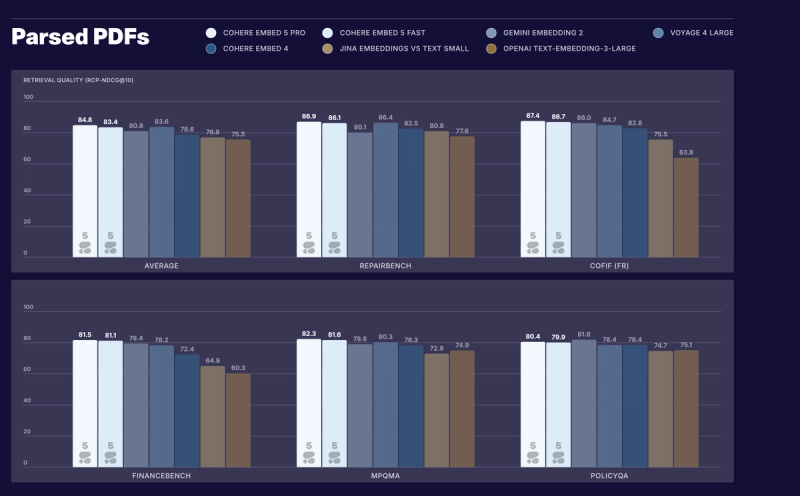
Our parsed-document suite spans service documentation, corporate reports, SEC filings, product manuals, and privacy policies. Embed 5 Pro achieves the highest average across the suite at 84.8, ahead of Voyage 4 Large at 83.6, Embed 5 Fast at 83.4, Gemini Embedding 2 at 80.8, and Embed 4 at 78.6. The figure below highlights a subset of familiar public benchmarks, with Embed 5 Pro especially strong on financial documents represented by FinanceBench and CoFiF.
Page-image and fused text-image documents
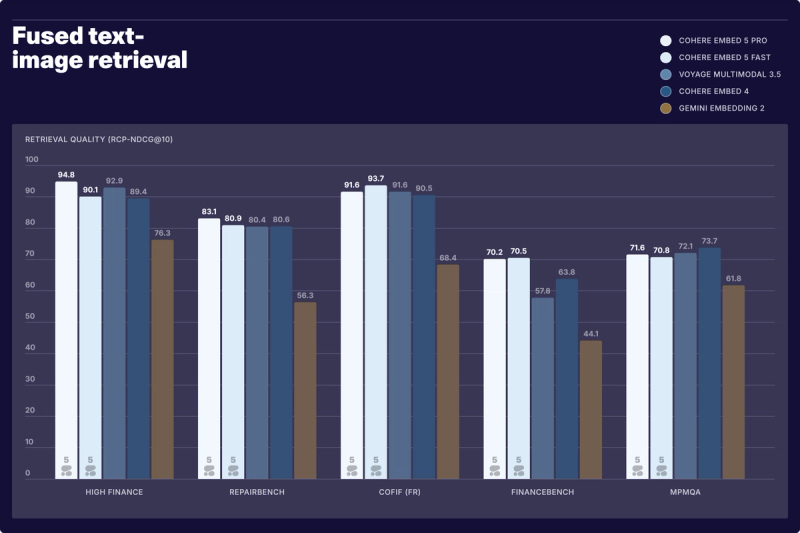
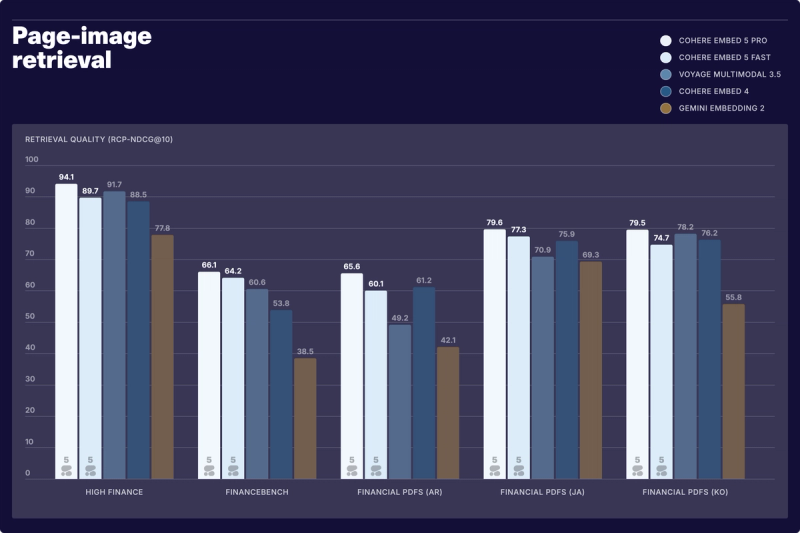
Some documents are better represented visually. Scanned pages, slide decks, schematics, and charts contain information that text extraction may miss. Embed 5 can embed page images directly (page-image), or combine an image with its metadata into a single vector (fused text-image).
On fused text-image corpora, Embed 5 Pro averages 82.3 across five datasets, ahead of Embed 5 Fast at 81.2 and Gemini Embedding 2 at 61.3. Pro outperforms Gemini Embedding 2 on every dataset in the suite. Page image retrieval is also robust: Embed 5 Pro continues to lead on financial datasets, averaging 77.0 from five datasets, ahead of Embed 5 Fast (73.2), Embed 4 (71.1), Voyage Multimodal 3.5 (70.1), and Gemini Embedding 2 (56.7).
Multilingual
Embed 5 is trained on more than 100 languages, with particular focus on the languages most used by our global customer base.
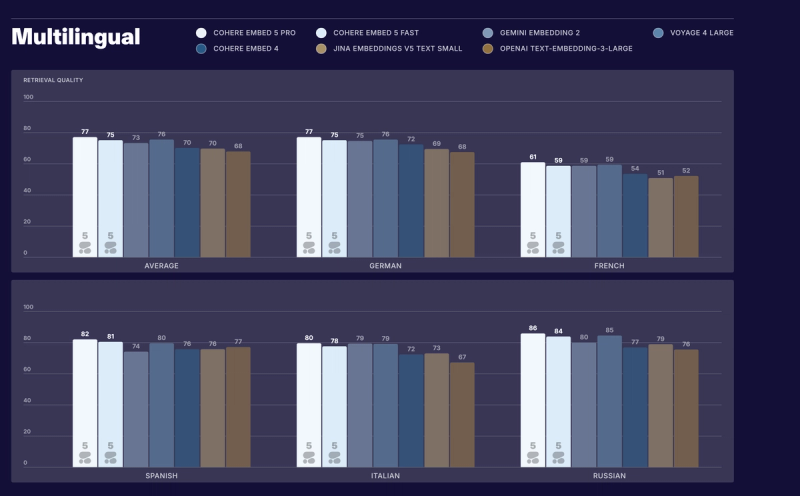
Across German, French, Spanish, Italian, and Russian, Embed 5 Pro achieves the highest average of the models we tested: 77, compared with 76 for Voyage 4 Large, and 73 for Gemini Embedding 2. It improves on Embed 4 by around 7 points on average, with the largest gains in Russian (+9) and Italian (+7).
The table below covers ten further languages where Embed 5 has made important strides against Embed 4. Pro’s largest gains are in middle eastern and subcontinent languages, notably Farsi (+13), Telugu (+12), and Hindi (+12). For the full list of multilingual evaluation results, click here.
| Language | Cohere Embed 5 Pro | Cohere Embed 5 Fast | Gemini Embedding 2 | Voyage 4 Large | Cohere Embed 4 | Jina Embeddings v5 Text Small | OpenAI text-embedding-3-large |
|---|---|---|---|---|---|---|---|
| Japanese | 87 | 85 | 90 | 87 | 83 | 83 | 80 |
| Chinese | 82 | 80 | 81 | 82 | 79 | 78 | 73 |
| Korean | 85 | 83 | 87 | 85 | 79 | 79 | 70 |
| Arabic | 83 | 79 | 87 | 86 | 72 | 71 | 67 |
| Farsi | 81 | 78 | 83 | 79 | 68 | 70 | 60 |
| Hindi | 80 | 77 | 84 | 83 | 68 | 73 | 59 |
| Bengali | 83 | 81 | 89 | 85 | 73 | 79 | 61 |
| Telugu | 80 | 76 | 91 | 89 | 68 | 82 | 63 |
| Indonesian | 85 | 83 | 88 | 85 | 79 | 79 | 81 |
| Thai | 82 | 75 | 88 | 84 | 75 | 78 | 67 |
Meet Embed 5 Fast
Embed 5 Fast is a lighter weight model built for latency-sensitive, high-volume retrieval. It costs a third less than Pro while retaining the same 128K-token context, multimodal inputs, multilingual coverage, and multiple compressed output formats.
That matters most on the query path, where embedding latency is paid on every search — and multiplied in agentic workflows that may issue dozens of searches per task. Fast’s smaller footprint also lowers serving costs in private deployments and speeds large ingestion and re-indexing jobs.
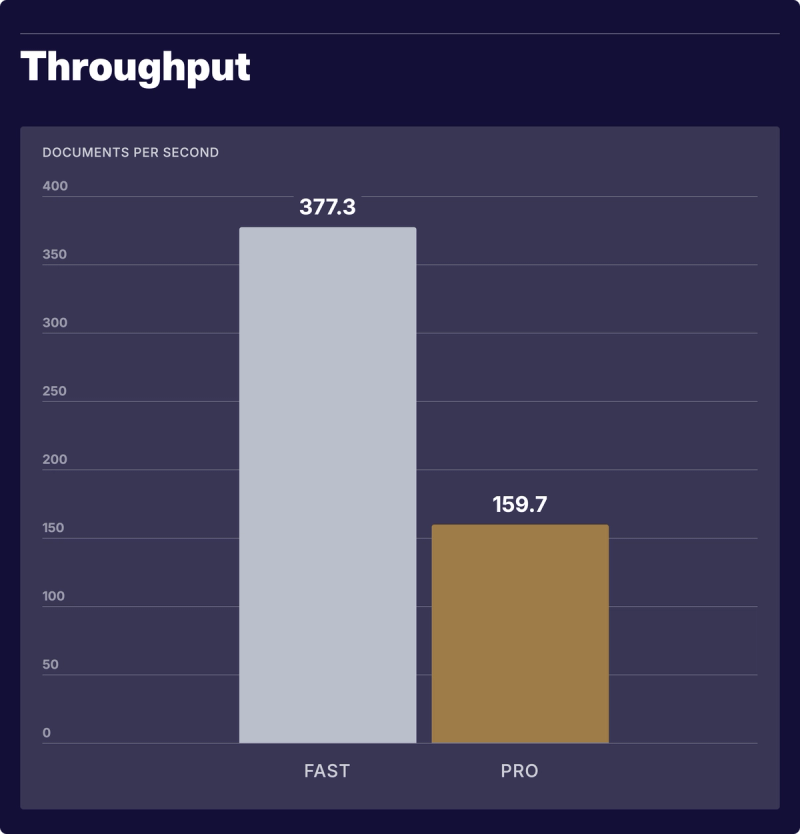
For document throughput — a closer proxy for indexing efficiency — Fast is consistently more efficient, delivering an average of 2.4× higher throughput than Pro across context sizes.
Performance
Fast raises the bar for compact embedding models. On ViDoRe V3, it leads Voyage 4 Nano by almost seven points and Jina Embeddings v5 Text Small, Perplexity, and Microsoft’s Harrier 0.6B by ten or more. It outperforms Qwen3-VL-Embedding-2B, despite being roughly half the size, by about 20 points. As seen above, its average also exceeds Gemini Embedding 2 and Voyage 4 Large on ViDoRe V3 and on financial retrieval. On parsed PDFs it exceeds Gemini Embedding 2 (83.4 vs 80.8) and trails Voyage 4 Large (83.6).
| Pro | Fast | |
|---|---|---|
| Use when… | Use for offline indexing and quality-critical retrieval — especially across complex documents, multimodal content, or nuanced queries. | Use on the live request path, especially for interactive search, agent loops, and other high-volume query workloads. |
| Financial Services | Bulk indexing of 10-Ks, earnings reports, tables, and footnotes for equity research; compliance or risk search over dense financial records. | Customer-service search, advisor copilots, transaction-support workflows, and agents issuing repeated retrieval calls. |
| Retail + Commerce | Product discovery across large multimodal catalogs, including nuanced attribute matching and image-plus-text retrieval. | Site search, shopping assistants, recommendations, and conversational product lookup serving large numbers of live queries. |
| Legal | Digitizing large legal archives, including contract histories, case files, regulatory materials, and internal precedent libraries. | Internal legal knowledge search, clause lookup, matter search, and repeated retrieval within legal assistants or workflows. |
Two models, one embedding space
Pro and Fast share a single embedding space, so vectors from either model can be compared directly. We tested every corpus/query pairing across 40 development datasets spanning text, image, fused, and parsed-document retrieval.
That shared space lets teams choose each tier independently: documents can be indexed with Pro for maximum quality, while queries use Fast for lower latency and cost — without rebuilding the index. The cross-model combinations remain close to the same-model baselines (averaging just 1.6% and 2.7% losses for Fast and Pro queries, respectively), with no dataset showing a major failure.
For many customers, we recommend the following deployment pattern: index with Pro, query with Fast. It captures much of the quality gain of an all-Pro system while keeping Fast’s latency and cost during request.3
| Mean retrieval quality | Corpus: Fast | Corpus: Pro |
|---|---|---|
| Query: Fast | 96.6 | 98.4 |
| Query: Pro | 97.3 | 100 |
Cross-model retrieval. Mean nDCG@10 across 40 development datasets, normalized to Pro corpus + Pro query = 100.
Vector storage
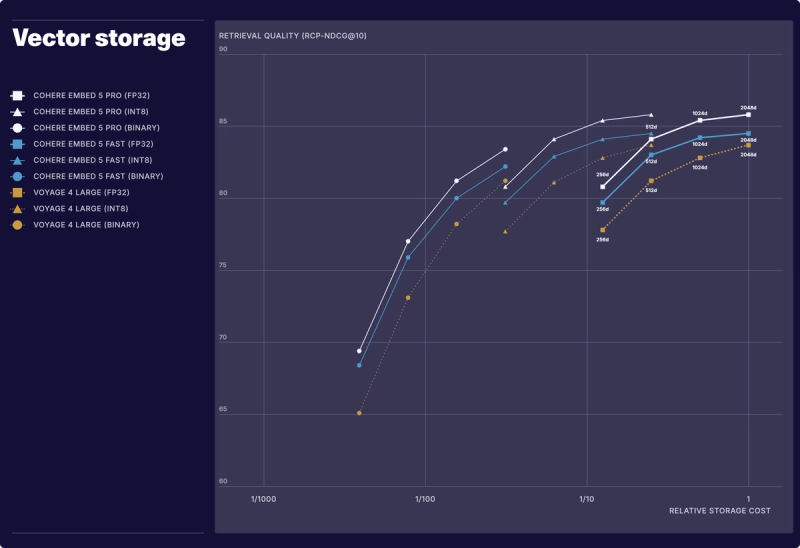
At enterprise scale, the vector index can cost more to operate than the model that generates it. Embed 5 supports Matryoshka representation learning and lower-precision outputs, letting teams shrink vectors and finely control the tradeoff between quality, storage, and search cost. These savings can be substantial: a 2,048-dimensional float32 vector requires 8 KB; a 1,024-dimensional int8 vector uses 1 KB; and a 256-dimensional binary vector just 32 bytes — a 256x reduction. Across 100 million chunks, that cuts raw vector storage from roughly 819 GB to 3.2 GB.
Importantly, int8 retains near-full-precision retrieval quality in both Embed 5 Pro and Fast. For most deployments, we recommend 1,024-dimensional int8 vectors as the ideal performance-efficiency point. Binary offers the smallest footprint, with some accuracy tradeoff, and is well suited to fast first-pass retrieval before higher-precision reranking.
Getting started
Deploy Embed 5 Pro and Embed 5 Fast through the Cohere API, Model Vault, Microsoft Foundry (Pro, Fast), and Amazon SageMaker (Pro, Fast), or use Embed 5 directly within North. For private deployments in your own VPC or on-premises, both models can be served with vLLM. Batch embedding is available for large-scale ingestion.
Build with the tools you already use. Embed 5 fits into existing retrieval stacks, with integrations across frameworks and vector databases, including LangChain, Haystack, Weaviate, Qdrant, Pinecone, Elasticsearch, MongoDB, Redis, Milvus, and OpenSearch. Read the documentation.
Start by creating an API key, then use the code snippets below to quickly make your first query.
import os, cohere, numpy as np

co = cohere.ClientV2(api_key=os.environ["CO_API_KEY"])

documents = [
    "Net interest margin narrowed 12 bps to 2.61% as deposit costs rose.",
    "Torque the mounting bolts to 45 Nm in a star pattern before refitting the cover.",
    "Employees accrue 1.5 days of paid leave for each month of service.",
]

doc_embeddings = co.embed(
    model="embed-v5.0-pro",
    input_type="search_document",
    texts=documents,
    output_dimension=1024,
    embedding_types=["float"],
).embeddings.float_

query_embedding = co.embed(
    model="embed-v5.0-pro",
    input_type="search_query",
    texts=["What happened to net interest margin last quarter?"],
    output_dimension=1024,
    embedding_types=["float"],
).embeddings.float_[0]

docs = np.array(doc_embeddings)
query = np.array(query_embedding)

scores = docs @ query / (
    np.linalg.norm(docs, axis=1) * np.linalg.norm(query)
)

print(documents[int(np.argmax(scores))])
What else
Meet the team behind Embed 5. Join us on X on October 8, 2026 to hear from our search and embeddings leadership about Embed 5, Parse 5, and what else we’ve been preparing behind the scenes.
Also, Compass Cloud, our managed search and retrieval platform, is now in private beta. Request access to try it on your own retrieval and agentic workloads.
Key contributors
Samarth Bhargav, Fabian Schmidt, Clifton Poth, Arthur Maciejewicz, Florian Schneider, David Rau, Dennis Zhao, Timothy Ang, Nils Reimers, Carlos Lassance
Footnotes
1 RCP-nDCG@10 requires evaluating embedding models in a two-stage retrieval setup, using their similarity scores to reorder a fixed candidate set. Scores therefore reflect reranking quality rather than first-stage retrieval performance, which we thoroughly evaluate elsewhere against nDCG and Recall.
2 The annotations and code needed to evaluate ViDoRe V3 with RCP-nDCG are available on GitHub.
3 Both sides must use the same output dimension. Compatibility also holds with Matryoshka truncation and int8 quantization, so the same pattern works with compressed indexes.