







Why culture matters
Culture underpins every aspect of human communication ranging from linguistic formality to societal norms. While today’s LLMs are increasingly multilingual, language coverage alone does not guarantee us multicultural awareness. Language is simply not an adequate proxy for culture. Previous studies have shown that as AI rapidly develops, digitally underrepresented cultures and communities are increasingly excluded from these technologies, and at increased risk of bias and misinformation. Further studies have demonstrated that AI systems often default to culturally dominant groups within languages (e.g., associating French primarily with France over other Francophone regions), context-switch to neighboring higher resource languages or regions (e.g., responding in Bengali when prompted in Assamese), and reinforce Western-Centric perspectives and narratives.
When AI is used as a companion to help us navigate cross-cultural interactions—international job interviews, workplace collaboration, or customer service exchanges–-can inadvertently cause harm when cultural differences are not properly understood.
The real-world problem
In our daily use of AI tools, we rarely think consciously about the role of cultural understanding in our interactions. But when major misunderstandings occur, when AI tools just don’t “get” our context, when we have to meticulously explain how our situation is different from the situations that AI models have learned to assume as default— then often the culprit is a lack of cultural understanding.
So which contexts specifically require cultural awareness? Do users have to find workarounds to make AI work for their use cases? To find the answers to these questions, we conducted a survey to understand how individuals from diverse cultural and linguistic backgrounds experience AI systems, particularly large language models (LLMs) like chat-based or generative AI tools. For the purposes of this study, we did not require participants to specify which AI models they referred to in their responses, and assume that these responses cover a broad range of frontier models given the diversity of participant occupations and regions.
We focused on understanding three main objectives: (1) identifying situations where cultural awareness is crucial in real-world AI interactions, (2) evaluating whether current AI systems adequately reflect social norms, communication styles, local knowledge, and cultural references across different cultures, and (3) documenting any cultural awareness limitations users encounter.
Our online survey recruited participants via social media platforms and research community outreach. All participation was voluntary and responses were collected anonymously and with consent to release aggregated results and quotes.
What the data shows
We received 81 responses in total from participants from over 22 countries around the world. Approximately half of participants (48.7%) were aged 25–34, with the remaining participants distributed across age groups ranging from 16 to 64 years old. While the majority of participants are fully fluent in English, over 80% of participants indicated regularly communicating in languages other than English. Our survey participants are regular users of AI: the large majority uses AI (85.2%) at least on a daily (if not hourly) basis, and only 3.7 percent use AI sporadically (less than weekly). Half of our participants work in the tech sector or engineering where coding agents are the most frequent use.
The language switching problem
Of the participants that indicated that their primary language was not English (83%), 89.5% reported switching from their primary language when interacting with AI. The main reason for switching was the perceived higher quality and accuracy of responses, with English being the most commonly adopted alternative language. This is alarming, because it means that the AI Language Gap hinders AI tools to have the same utility for users that are not proficient in English.
Where AI falls short
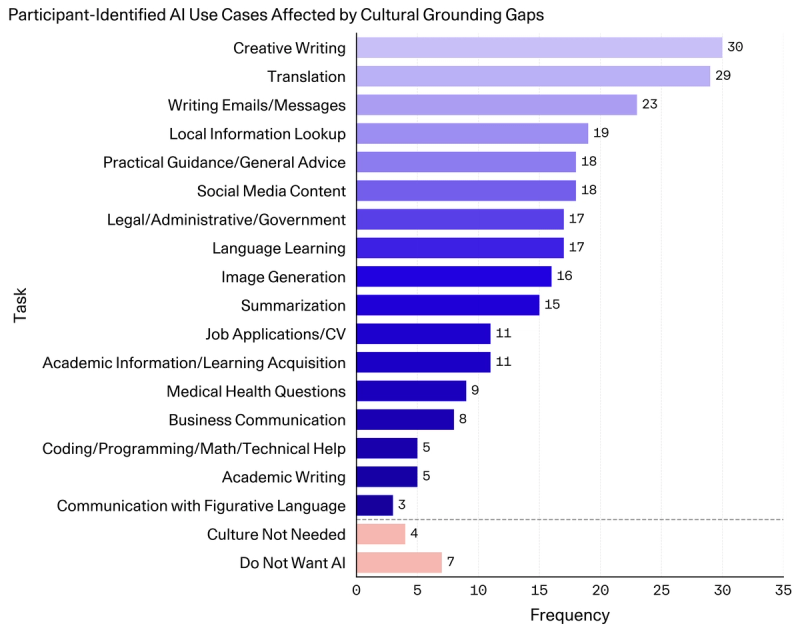
Over one-third of respondents (38%) felt that AI does not adequately understand their cultures, giving a score of <5 out of 10. When asked which tasks participants would like to use AI for more, but currently do not due to lack of cultural awareness, the top answers were writing-based tasks of creative writing, translation, and communication writing. Local information look-up, practical guidance, legal and government-related tasks, social media content generation, and medical health questions, were also reported to lack cultural awareness. We additionally asked participants to describe typical failure cases. See some examples below:
Violating cultural norms
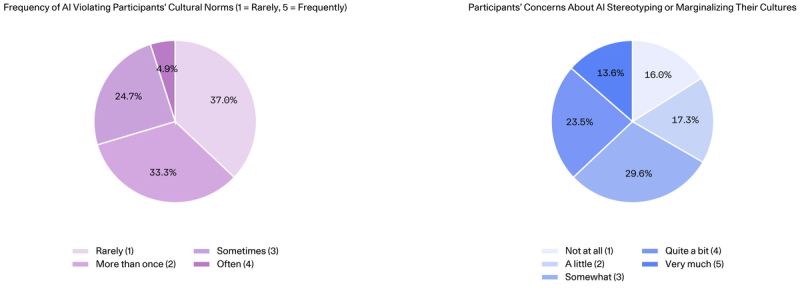
The majority of participants (63%) indicated that their cultural norms have been violated at least once when interacting with AI. Participants commonly cited problems with defaulting to cultures that appear more dominantly represented in AI, in responses from communication norms to historical narrative perspectives. To give some concrete examples: One participant identifying their cultural background as German, stated “AI messes up formality, lacks cultural nuance, is bad at gendering”, another participant of Korean background said “Sometimes AI gives responses that feel too generic or Western-centric.” Other participants commonly reported when prompting in Hindi or Punjabi, that AI defaults to Western-centric norms in social situations and communication styles, and fails to capture context in code-switched languages, all of which can make responses feel unnatural and even impolite. Multiple participants reported that while using AI models in Egyptian Arabic/Korean/Japanese/Italian/Croatian or Hindi, AI frequently presented Western narratives of historical events while overlooking the practices, traditions, and perspectives of their respective cultures.
Fears of marginalization
As AI increasingly shapes our lives—from how we work and learn to how we access information—it often defaults to dominant cultural perspectives, creating a risk of further marginalizing other cultures. The language requirement alone (needing to speak English) hints at this problem, but the deeper concern is how users might gradually adapt to AI recommendations rooted in these dominant cultures, potentially weakening their connection to their own heritage. Culture is nurtured through human interaction, and this is precisely where AI cannot compensate. Our survey participants share this apprehension: 67% expressed moderate to strong agreement that AI would further marginalize their culture in the future or reduce it to stereotypes (scoring 3 and above on a 1-5 scale).
Why this matters in real world scenarios
63% of respondents indicated a 3 or more out 5 when asked if they use AI to understand cultures apart from their own. If users are using AI to gain cross-cultural understanding, it is even more important that cultures are adequately represented and norms are not misrepresented in order to prevent further misinformation.
There is also an economic dimension that often goes unspoken. AI is increasingly a productivity tool for tasks like writing, research, coding, communication, and decision-making. If AI works significantly better for English-speaking Western-context users, then the productivity gains of the AI era will flow disproportionately to populations that are already privileged.
One survey participant articulated the practical vision well: “I would like to see improvements in areas like job applications, workplace communication, and local guidance, where cultural nuance really matters. Better handling of mixed languages (like English with Hindi or Punjabi) and more region-specific understanding would make AI feel more natural and trustworthy.”
If these cultural hurdles are not addressed, the usage dynamic is self-reinforcing: users who receive poor results are less likely to keep using the AI tools which means less usage data from these communities flow back into the model development cycle—and without explicit interventions, models improve even less over time for these users and the cultural gap compounds.
What should cultural-aware AI look like?
Taken together, these findings highlight a clear need for culturally aware AI. What would culturally aware AI actually look like? There are many features to aim for: AI would apply region-specific localization rather than defaulting to cultures more dominant in AI training. It would calibrate formality and directness to the cultural context of the user. It would cite more diverse sources when discussing global history. It would handle code-switched language naturally. It would give guidance that reflects the user's cultural background and the social or legal context they’re currently in.
As AI becomes embedded in every layer of daily life, cultural awareness needs to be a core design requirement, built in models from the start in order to build technologies that reflect and respect the needs of users globally.