The IOL-AI Challenge: An Open Challenge towards Advancing Linguistic Reasoning
We hosted an open competition on unseen linguistic reasoning problems to measure and advance AI reasoning skills. The official IOL 2026 jury graded AI solutions, and one frontier model scored equivalent to a gold medal.
Eduardo Sánchez*, Rita Berrada*, Dan-Mircea Mirea*, Sara Rajaee, Alexander Piperski, Ana Meta Dolinar, Boris Iomdin, Andrey Nikulin, Mariya Shmatova, Marzieh Fadaee, and Julia Kreutzer
*First authors
Abstract
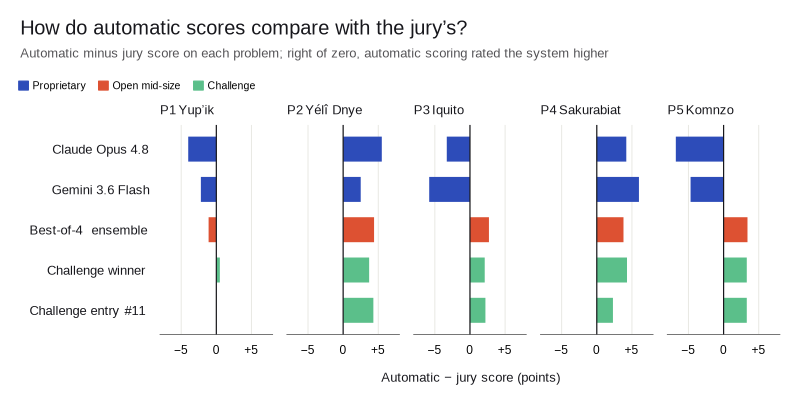
Reasoning in LLMs is overwhelmingly studied in domains that provide a model with rules: mathematics and code. Linguistic puzzles invert this: the solver must first discover the system before reasoning within it. We present the IOL-AI Challenge, an open-science competition run on the unseen problems of the International Linguistics Olympiad (IOL) 2026 Individual Contest, evaluated both automatically and, for the first time, by members of the official IOL Jury under the same rubrics applied to human contestants. The challenge drew 731 submissions from 46 teams under a strict compute budget (one T4, 30 mins). We additionally benchmark 15 unconstrained frontier and open models, with Claude Opus 4.8 earning a jury score equivalent to a gold medal, while both resource-constrained systems we submitted for jury grading scored in the range of the bottom 5\% of contestants. Capability was not determined by scale: 14B submissions outperform models twice their size, and gains come from decoding and output-handling rather than model capacity. We also found that automatic metrics rank systems exactly as the jury does, but compress the scale, upscoring weak systems by ${\sim}13$ points and understating strong ones.
Can AI solve a problem in a language it has never seen?
Why linguistic reasoning matters
Ask a frontier model to solve an olympiad math problem, and there is a good chance it gets it right. Now hand it a few sentences in a language spoken on a single island in Papua New Guinea, with their English translations, and ask it to work out how the language works. Suddenly, things get much more interesting.
Reasoning has become the main lever for improving language models. Instead of only making models bigger or training them on more data, today's systems spend more effort at answer time: they think in intermediate steps, explore alternative paths, check their work and revise it. The progress has been remarkable, and almost all of it is measured on math and code.
But notice what those two domains have in common. They come with the rules already written down. A model working through an equation never has to ask what the rules of arithmetic are. Most reasoning benchmarks work the same way: they give the model the rules and measure how well it reasons within them. But can a model discover the rules on its own, and then reason inside them?
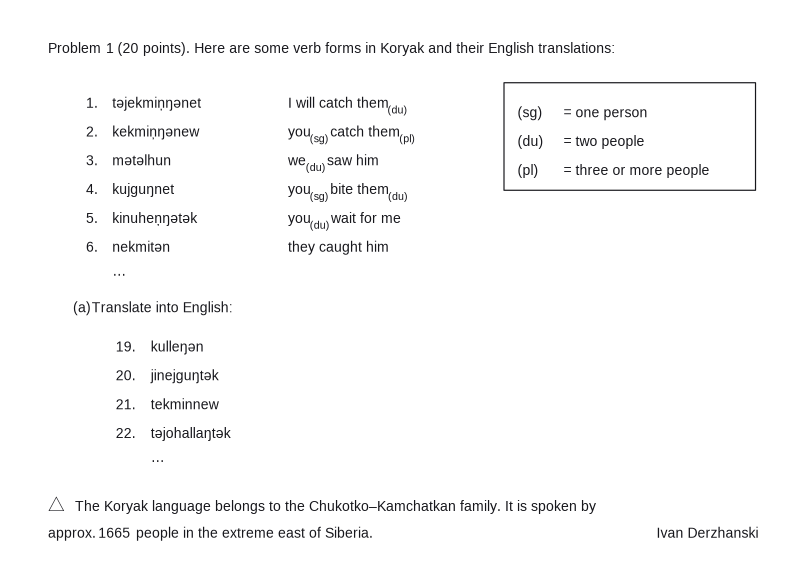
Linguistic problems test exactly that. Given a few sentences from an unfamiliar language, the solver must spot recurring units, guess the grammar, form hypotheses about meaning, and use them to produce new forms. None of the rules are given; all of them have to be found in the data.
Until now, every study that put models to this test found that even the strongest ones struggle. We wanted to find out whether this still holds today. So we evaluated models without relying on automatic metrics alone, and had their answers graded by specialists who grade humans on exactly these tasks.
What a linguistic problem looks like
A linguistic problem gives you a small amount of data from a language you have never seen: a few sentences with their translations, a numeral system, or a sample of a script. From that data alone, you are asked to translate new sentences, fill in missing forms, or match phrases to their meanings.
The problems are designed to be self-contained. Everything you need is in the problem itself, and no prior knowledge of the language is required. The languages are deliberately chosen to be very low-resource, so that no solver starts with an advantage.
Finding the right answers is only half the task. Contestants also have to explain the rules they discovered, using only concepts from school, like verbs, suffixes or consonants. No linguistics training is needed, and most contestants prepare simply by solving past problems.
These problems come from linguistics olympiads, the largest of which is the International Linguistics Olympiad (IOL). It started in 2003 with 36 students from 6 countries. The 2026 edition, held in Bucharest, brought together 255 contestants from 46 countries. Each contestant has six hours to solve five individual problems, followed by a team problem solved in groups of four.
Solutions are graded by the IOL jury, an international group of linguists, polyglots and former contestants. Each problem comes with a rubric that awards points for the answers, and separate points for each rule correctly identified in the explanation.
The IOL-AI 2026 competition
We ran IOL-AI 2026, an open competition in which participants submitted models to solve the five problems of the IOL 2026 Individual Contest, the same problems the students would solve at the olympiad a month later.
A general concern when benchmarking models is knowing whether they answer by reasoning, or by remembering things they saw during training. By taking place before the olympiad, our competition ruled that out. At that point, the problems were still strictly confidential. They were uploaded directly by IOL members, so no one had seen them: not the organizers, not the participants, and not the IOL contestants. No model could have encountered them during training, which ensured we were actually putting their reasoning skills to the test.
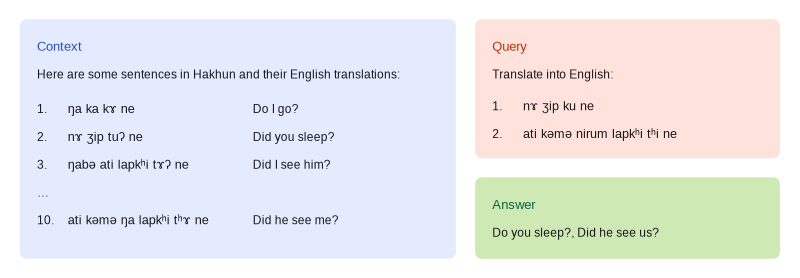
To give the problems to a model, IOL members converted each one into the Linguini format: a context with the data, a query with the question, and the expected answer.
The competition was hosted on Hugging Face and ran for a month, closing on the day the IOL began. Teams submitted a model along with a script to run it, and we ran each submission without internet access, on a single NVIDIA T4 GPU with a 30-minute limit. We chose these limits on purpose. The goal was to advance open research, which doesn't happen if every team relies on the largest proprietary models.
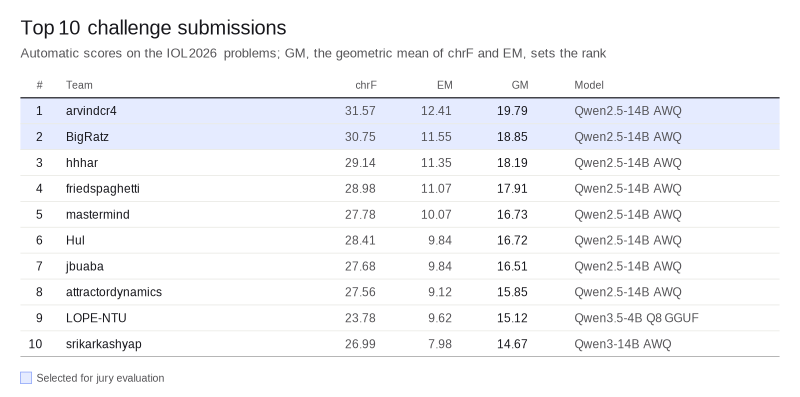
To give teams a starting point, we provided baselines built on models from 1.5B to 14B parameters. The strongest, at 9.4, used Qwen2.5-14B-Instruct, compressed to fit on the T4. It is the largest model that we were able to run within these limits.
Answers were scored automatically against the official solutions, using exact match and chrF, a metric that gives partial credit for getting part of a word right. The questions were split into a public and a private set. During the competition, teams only saw their score on the public set, while the final ranking used both. This kept teams from simply tuning their models to the questions they could see, and pushed them toward approaches that generalize to new problems.
The results
By the deadline, 46 teams had sent in 731 submissions. The winner scored 19.8, more than double our best baseline at 9.4, using exactly the same 14B model. Nine of the top ten used it too, so what made the difference was not the model, but how teams ran it.
What the top teams did
Since all submissions had to be public repositories, teams could look at each other's work, and good ideas spread quickly. As a result, the top entries ended up sharing a lot in common:
They lowered the repetition penalty, a default setting that discourages models from producing the same characters several times in a row.
They dropped chain-of-thought prompting entirely.
They took a first answer, sampled a few more, and only replaced the first one if several of the new answers agreed.
They let answers get shorter as the clock ran down, and saved each answer as soon as it was produced, so a timeout still left a valid submission.
They put real effort into extracting a clean answer from whatever the model produced.
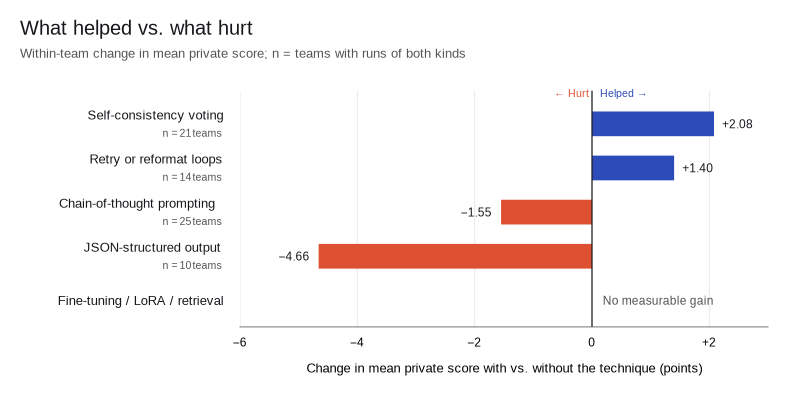
We also compared runs from the same team with and without each technique. Sampling several answers and keeping the one the model agreed on was worth about 2 points on average, and retrying badly formatted answers about 1.4. Other techniques hurt. Chain-of-thought, tried by 33 teams, cost 1.6 points: the reasoning ate into the 30 minutes and buried the final answer in text that then had to be parsed. Asking for JSON output was worse still, at −4.7. And fine-tuning on past olympiad problems didn't help at all, which fits problems built so that everything you need is in the problem itself.
How do unconstrained models do?
Since the competition only allowed small models, we also ran 15 existing models with no limits to complete the picture. These include the biggest, most recent reasoning models, both proprietary and open, as well as mid-size open models of 27B to 32B parameters, about twice the size of the competition models, which bridge the gap with the competition's constraints. Because mid-size models are not competitive on their own, we also combined four of them into a "best-of" team, taking for each question the answer of whichever one did best. This gives the ceiling of what mid-size open models could reach.
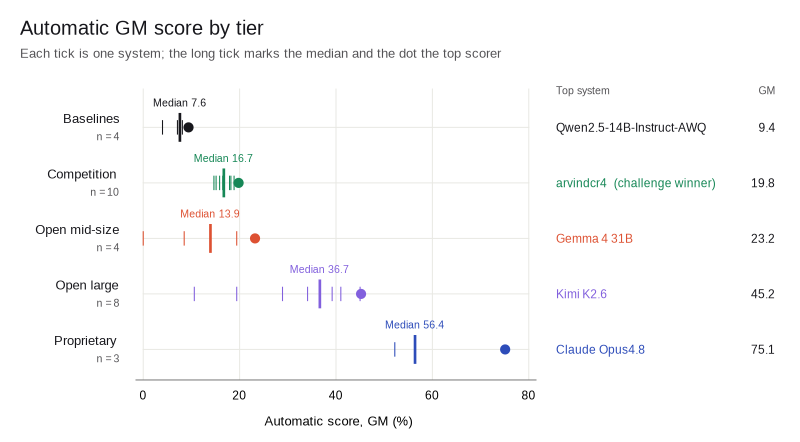
Proprietary models are clearly on top, with Claude Opus 4.8 ahead of Gemini 3.6 Flash and GPT 5.6 Sol by 19 points. Large open models follow after another 7-point gap, with a wide spread between them. Mid-size models score lower still. Their best-of team scores about 10 points higher than the best of its four members, which is enough to catch up with some of the large open models.
But performance isn't just about size. When we put the competition entries on the same scale, the constrained 14B models beat some of the unconstrained mid-size models. Linguistic reasoning is not something models are trained on, and most of them struggle with the output format, so tweaking how a model is run goes a long way. Even so, all open systems stay far below the frontier.
So why are the strongest models so far ahead? You may wonder whether they simply know more about these languages. Our analysis suggests that while they do have some knowledge of them, it does not explain their ability to solve the problems. More details are in the paper.
What the jury said
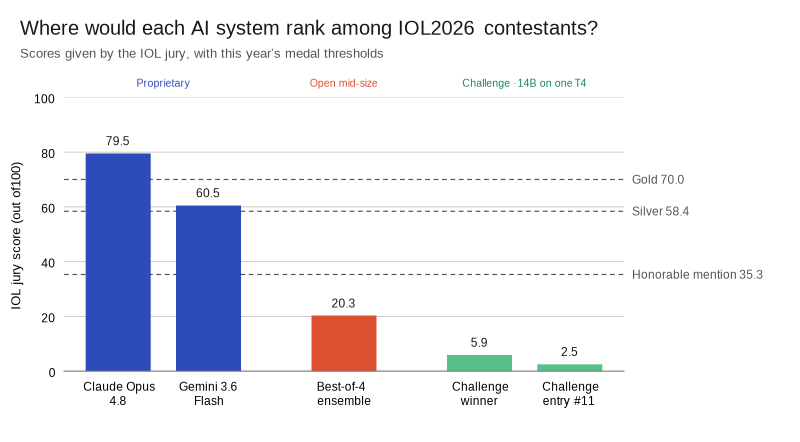
Grading at the IOL rewards not only correct answers but also the explanation of the rules behind them. For competition entries, this meant submitting an additional explanation field to be eligible for jury grading. We selected five systems to cover the full range: the two best frontier models, Claude Opus 4.8 and Gemini 3.6 Flash, the best-of team of mid-size models, and two entries from the open competition. The jury then graded them exactly as they grade the students, using the same rubrics and without knowing which model wrote which solution.
The jury ranked the systems in the same order as the automatic scores. Claude Opus 4.8 scored 79.5, above this year's gold medal threshold of 70, which would have placed it fourth among the 255 contestants. Gemini 3.6 Flash scored 60.5, at silver level (the lowest silver was 58.4). All other systems fell below the honorable mention threshold of 35.3, meaning they did worse than half of the contestants, and the two competition entries would have ranked in the bottom 5%.
Although the order is the same, the scale is not. The two proprietary models scored about 4 points higher from the jury than from automatic scoring, while the three other systems scored about 13 points lower. Automatic scoring overrates weak systems because it ignores their poor explanations and gives partial credit to wrong answers. It also underrates strong ones, because a correct rule written out in an explanation earns points from the jury but nothing automatically.
How AI solutions differ from students'
The jury also noticed clear differences from the solutions they usually grade. Since we asked for an explanation per question, models sometimes gave different, even contradictory, analyses of the same phenomenon within one problem. They were more verbose than students and their rules more convoluted. Weaker models hallucinated words or sounds that don't exist in the data and hedged with "typically" or "often" where the data support a firm rule. Even frontier models missed broad patterns that students found, and used linguistic jargon without always backing it up.
Overall, models do find linguistic structure, and the best reach medal level. The difference is in how they use it: students build one compact analysis that explains the whole problem, while models reason from one question to the next. This only becomes visible once explanations are graded.
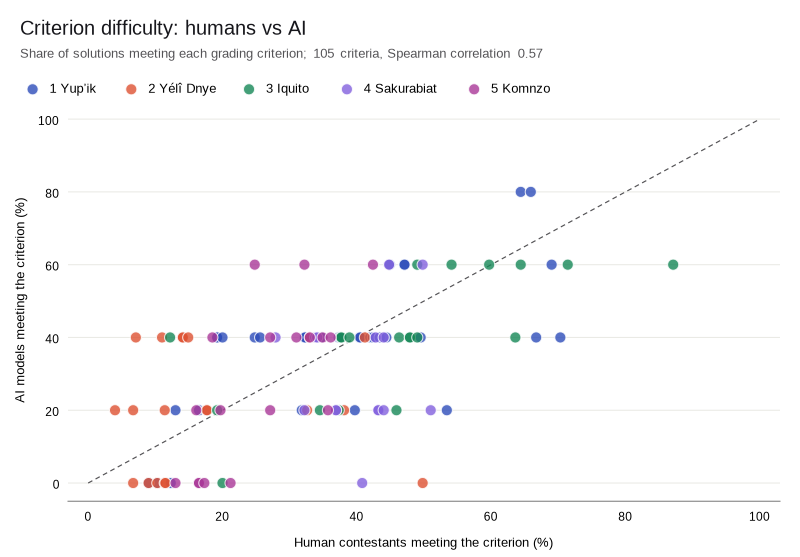
There were similarities too. Models often described phenomena in the same order as students, and what was hard for models was largely what was hard for students. Some problems were easier for models (Komnzo), others for students (Iquito), but part of the difficulty seems to lie in the problem itself, whoever the solver is.
What this means and what's next
IOL-AI 2026 is the first evaluation of language models on genuinely unseen olympiad problems, graded by the same jury that grades the students. Since the problems were unreleased, no model could have seen them during training. Solving them means inferring a language's system from the data alone, which makes this a true test of reasoning.
Prior work found that frontier models underperform on these problems. That is no longer the case, as models reached medal level for the first time. But only proprietary models did, and since their training and reasoning remain inaccessible, this does little for open research.
Under tight constraints, how you run a model matters a lot, and the competition winner more than doubled our baseline with the same 14B model. Still, no constrained entry reached honorable mention, and even the best-of team of mid-size open models stays far from the frontier. Closing this gap with open, efficient systems is the problem this challenge poses.
Expert grading also changes what scores mean. Medal level was reached under the jury's rubrics, not through string matching, and automatic metrics get the ranking right but compress the scale. The jury also noticed patterns in the models' explanations that set them apart from students: contradictions, hedging, hallucinated words… None of this is visible when only final answers are scored.
We release the jury evaluations, model outputs and scores on GitHub to support progress on linguistic reasoning and on how we measure it.