




Outdated
Past launch
This article may no longer be accurate and is only kept for informational purposes.
Today we’re releasing Embed 4: our latest state-of-the-art multimodal embedding model that enables enterprises to add frontier search and retrieval capabilities to AI applications — a necessity for businesses building assistants or agents that need to understand their business context.
Embed 4 offers customers:
- State-of-the-art multimodality: Embed 4 is uniquely capable at accurately and quickly searching multifaceted documents such as intricate PDF reports and dynamic presentation slides — whether the document is text-based or includes images, tables, graphs, code, and diagrams.
- Breakthrough context length: Embed 4 can generate embeddings for documents up to 128K tokens (around 200 pages) in length such as annual financial reports, product manuals, or detailed legal contracts.
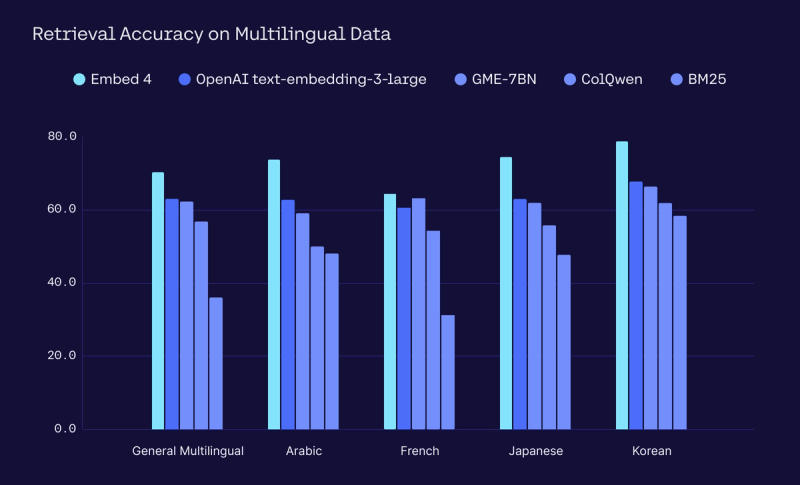
- Leading multilingual capabilities: Embed 4 is multilingual across 100+ languages including key business languages such as Arabic, Japanese, Korean, and French to support global enterprises.
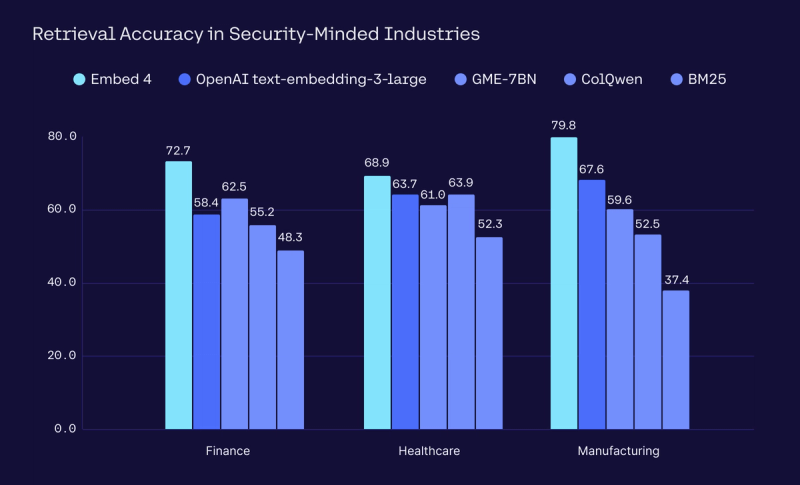
- Enhancements for security-minded industries: Embed 4 is optimized with domain-specific understanding of data from regulated industries such as finance, healthcare, and manufacturing. It can be deployed in virtual private cloud (VPC) and on-premise environments to keep data secure.
Existing embedding models fail to natively understand complex multimodal business materials, leading companies to develop cumbersome data pre-processing pipelines that only slightly improve accuracy. Embed 4 solves this problem, allowing enterprises and their employees to efficiently surface insights that are hidden within mountains of unsearchable information.
Unlocking multimodal and multilingual search for global organizations
Embed 4 enables organizations to search their unstructured documents, where a large majority of their important data resides. It is uniquely capable of generating high-quality representations of complex mixed-modality documents – all within a unified vector. This capability additionally empowers businesses to build applications that can understand reference images alongside text questions, enabling users to use new search patterns to accelerate their productivity.
In particular, Embed 4 excels in regulated industries such as finance, healthcare, and manufacturing. In addition to strong general business knowledge, the model is optimized with domain-specific understanding of these industries so that it can identify relevant insights within common documents such as:
- Finance: investor presentations, annual financial reports, M&A due diligence files
- Healthcare: medical records, procedural charts, clinical trial reports
- Manufacturing: product specification documents, repair guides, supply chain plans
Language should never be a barrier to accessing information. Embed 4 delivers leading multilingual understanding across 100+ languages such as Arabic, French, Japanese, and Korean. It also is capable of searching across languages, ensuring employees can find critical data regardless of the language it's stored in or the languages they speak.
Business data tends to be imperfect. Certain documents have spelling mistakes, formatting issues, or have pages with landscape orientation that are meant to be in portrait. To ensure these issues don’t harm the accuracy of search results, Embed 4 was trained to be robust against noisy real-world data. It is also performant at searching over scanned documents and handwriting. These formats are common in legal paperwork, insurance invoices, and expense receipts. This capability eliminates the need for complex data preparations or pre-processing pipelines, saving businesses time and operational costs.
Crucial foundation for agentic enterprise AI applications
AI systems must understand the context in which they operate to be useful. AI assistants deployed within businesses do this through a process called Retrieval-Augmented Generation (RAG). In essence, the generative AI model (i.e. Command A) that powers the conversational experience will rely on a search engine – that is connected to proprietary company information – to source relevant information to user questions before responding. This improves the usefulness of answers and mitigates against hallucinations.
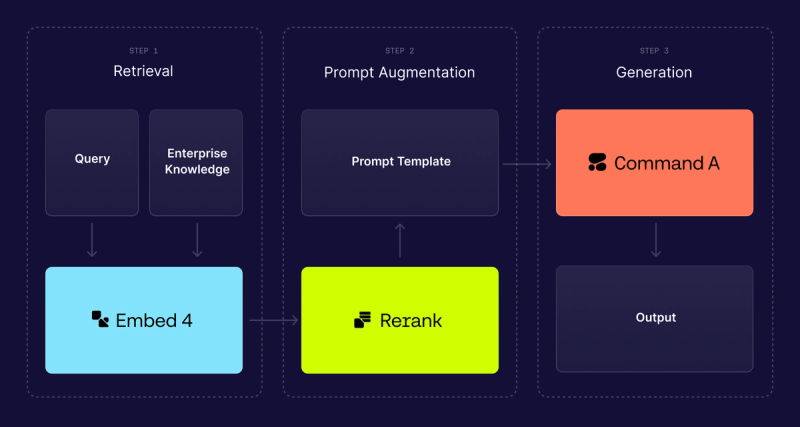
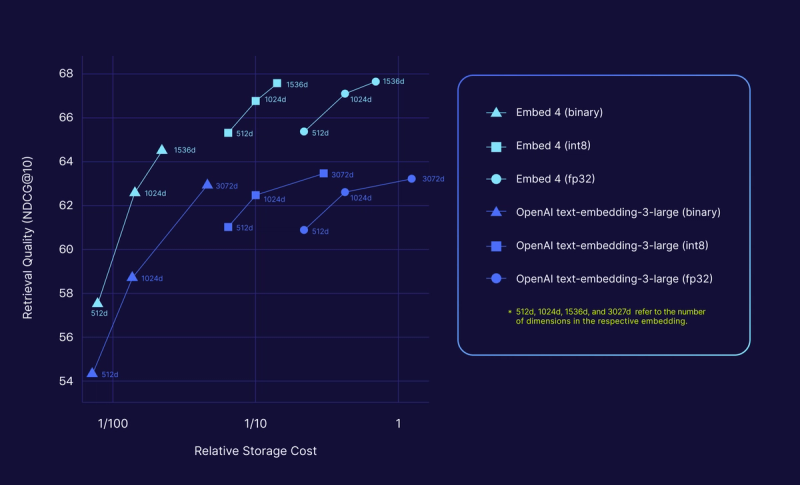
Embed 4 is the optimal search engine for enterprise AI assistants and agents. In addition to strong accuracy across data types, the model delivers enterprise-grade efficiency. This allows it to scale to meet the demands of large organizations. Further, because high data storage costs lead to reduced ROI on technology investments, we designed Embed 4 to output compressed embeddings. This helps organizations to save up to 83% on storage costs while maintaining search accuracy.
We are excited for businesses to use Embed 4 as the foundation of their search and retrieval pipelines, powering the next generation of AI applications across industries. Embed 4 also seamlessly integrates with North, our secure AI agents platform, by powering the semantic search capabilities of the end-to-end search system found in Compass. Our vertically integrated technology stack enables businesses to seamlessly integrate their data across workplace tools, build custom AI agents to suit their unique needs, and maintain control over their data behind the secure firewalls of their private environment.
Embed 4 is available today
Embed 4 is available today on Cohere’s platform and Microsoft Azure AI Foundry.
“We’re expanding our partnership with Cohere by bringing two of their latest enterprise models — Embed 4 and Command A — to Azure AI Foundry. These state-of-the-art models enable powerful, efficient, and secure AI solutions. Critically, we are excited to see how these models enhance agentic capabilities: grounding responses in richly contextualized data — core to building reliable, observable AI agents that can act autonomously and deliver enterprise-grade performance.”
Asha Sharma, former CVP of Product, AI Platform, Microsoft
Embed 4 is also available on Amazon SageMaker and for private deployment into any VPC or on-premise environment. To learn more, contact our sales team and find more technical details in our developer documentation.