






Consider this age-old riddle: “What kind of house do you enter blind and leave seeing?” While English speakers may instantly recognize the answer as “a school,” AI models can struggle with the same riddle if asked in another language. A Cohere Labs open science project revealed the complex nature of interpretation, and the results were surprising.
The word "riddle" comes from the Old English "rædan" which means "to interpret" or "to advise,” suggesting that riddles are about interpretation and insight rather than just guessing. Riddles thrive on ambiguity but have specific solutions. Just as humans get better at riddles through practice and feedback, AI improves its abilities through machine learning.
“We could not believe our eyes… It is not ‘just’ research anymore, it IS a movement.”
- Boczka Károly
Hungarian diplomat Boczka Károly was actively exploring opportunities in AI research. When he decided to build tricky, Hungarian trivia-style riddles to test if AI models recognized cultural clues, he received stunning results. The models’ answers sounded right, but they weren't right. The models were missing culturally specific facts, and in certain instances, were hallucinating. In an open-science community discussion around culture in AI hosted by Cohere Labs, Boczka shared his findings with Julia Kreutzer. Kreutzer, the Staff Research Scientist at Cohere Labs, saw immediate potential to test the gap between AI fluency and cultural knowledge. Together, they globally scaled a project to test the fluency, logic, and reasoning within models trained mostly on English data and the blind spots behind each answer.
Participation in the project did not require expertise beyond identification with a culture and a commitment to writing and evaluating riddles, which opened the door for research participants of any age and background. An open call on social media and within the Cohere Labs existing research communities invited people to join the project with no entry criteria, deliberately removing barriers that typically restrict participation. The community gathered on Discord and built its own benchmarks across cultural segments like sports, history, and politics, with each question designed as a riddle.
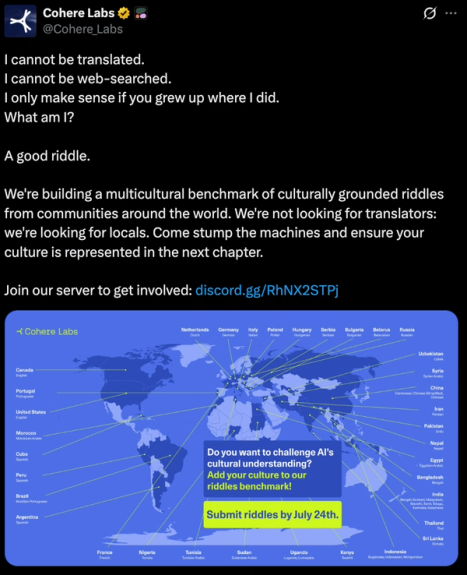
Mr. Boczka's idea quickly grew into an international initiative. “We could not believe our eyes,” he says. “We had more than 100 contributors from more than 50 countries. It is not “just” research anymore, it IS a movement.” He continues, “Our collective was so dedicated, independent, and cooperative that the whole project grew like a well-planted plant.” Two contributing members within that well-rooted community were 15-year-old American Henry Gagnier and Canadian retired schoolteacher Jane Smith.
While most teenagers might be hesitant to join a global research team of this magnitude, Henry Gagnier’s infectious enthusiasm outweighed any preconceived notion of what a “typical” research team member should be. “I'd say that AI research is for everybody. There are so many different aspects of AI research. We needed people from many different cultures, and it's not ‘AI skills’ that are helpful for building this benchmark, it is real cultural knowledge.” When asked if he was intimidated or surprised by the group, he says, “What surprised me most was their inclusivity and openness, because I was always kind of intimidated as a high school student, joining this project and saying I want to be a lead for this team. But everyone was so nice. It was an amazing experience.”
This project, while grounded in cultural and semantic nuance, provided him with more insight into research and a possible future within it. “It gave me a nice sneak peek into what actual researchers are doing,” Gagnier says. “I want to continue research in this field. I'm doing some projects to further my knowledge in this field now, so I think this project is a good educational experience, and it's definitely changed my outlook on where I want to go in the future.”
As a retired teacher, Jane Smith took what she calls a “teacher approach” to her research. “When I would evaluate kids if they got something wrong, I always tried to back think it, like okay, ‘Where did it go wrong?’ ‘What led to this completely wrong answer?’ There must have been something that led them there, and so I found myself doing that a lot of the time with the evaluating.” She also tried to anthropomorphize her process by incorporating things like tigers or crabs within her riddles to gamify the logic as a powerful teaching tool.
Each solved riddle or generated puzzle became a data point that refined the project’s understanding of language and logic. What made the riddles project particularly meaningful was that it wasn’t just about entertainment, but it demonstrated interpretive capabilities that define both riddles and AI.
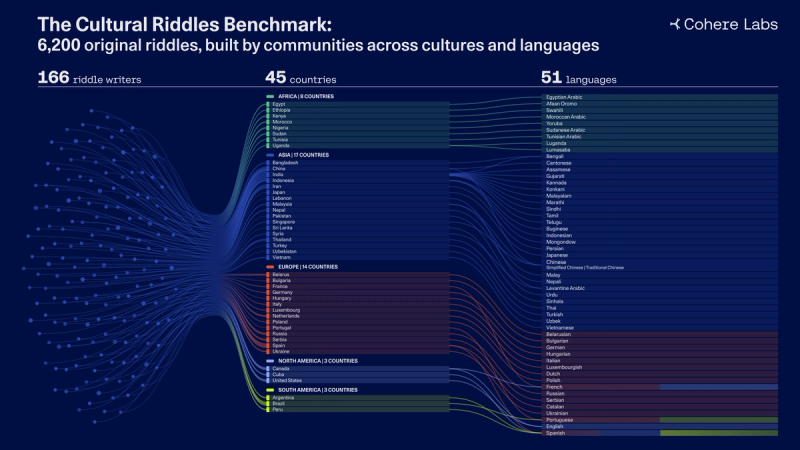
AI’s struggle with cultural riddles across different languages and contexts is potentially one of the most significant challenges in developing models. “I was kind of surprised because it wasn't just a lack of cultural understanding,” Gagnier says. “These models don't know this language at all, and I think Buginese is a fairly frequently spoken language. I'm surprised that these models still had virtually zero knowledge of the language, and that translated to zero knowledge of the culture as well with how we were evaluating it.”
The project underlines that intelligence isn't just about solving puzzles, but about understanding the human experience and languages behind them. The etymology of "rædan" (to interpret) takes on new depth when we consider that interpretation must be culturally grounded to be meaningful.
Mrs. Smith reveals a widely shared societal concern regarding AI cultural model accuracy. “I was surprised at how few times the models answered, "’I don't know’. But instead, it gives these quite authoritative sounding [answers] which would lead one to think, ‘Oh, this thing knows what it's talking about’.”
What the team found unsettling were finite conclusions from models that sounded unwaveringly confident despite wrong answers. Recognizing this blind spot, Mrs. Smith says, “The scary part to me is that it sounds so authoritative and people are looking for authoritative answers.” She adds, “I don't think it's AI that's going to kill us. It’s our lack of critical thinking that's going to kill us.”
In an age where some worry that the human elements of daily life are quickly disappearing, the riddles research pushes for a rethink surrounding any resolution that lacks a human touch. In her wisdom, Mrs. Smith poses what may seem like an amusing play on words, but what just might be the decisive outlook on an AI cultural conundrum: “To err is AI. To critically think is human.”
There is an interesting space between human cognition and AI’s thinking. Cohere Labs is working on better contextual understanding by delving into confidence in today’s models. The riddles demonstrate that as AI grows more confident in its answers, we must remember that critical thinking keeps us human.